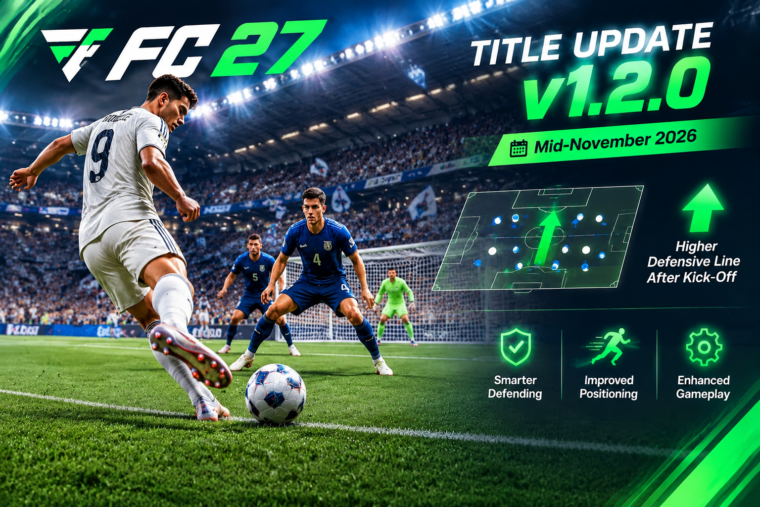
Kick-off should give both teams a reasonable opportunity to establish possession, yet defensive positioning in FC 27 has sometimes made the opening seconds unusually difficult to manage. When defenders retreat too close to their own penalty area, opponents can advance through the middle with limited resistance and create an immediate scoring opportunity. A direct forward pass can expose the space between midfield and defense before the defending team has time to reorganize. Alongside tactical adjustments on the pitch, Ultimate Team players are also considering squad improvements and resource decisions, including the role of cheap EA FC 27 Coins in keeping their teams competitive throughout the season.
EA has confirmed that this defensive behavior will receive attention in the upcoming Title Update v1.2.0, which is planned for mid-November 2026. The update will make the defensive line hold a higher position immediately after kick-off. This is a targeted positioning adjustment rather than a broad change to attacking speed, passing, or shooting. Its purpose is to give defenders a more effective starting shape when opponents attempt to move directly toward goal after the restart.
Why Kick-Off Defending Needs Attention
The problem begins when defenders drop too far back immediately after the restart. Instead of maintaining a position that allows the midfield and defense to work together, the back line can leave considerable space in front of the penalty area. An opponent receiving the ball in that space has more time to turn forward, identify a passing option, and move toward goal.
Direct attacking approaches can take advantage of this positioning. A quick pass into the central area may force the defending player to switch between several defenders while the attacking side continues moving forward. If the defensive line has already retreated, the opponent can reach a dangerous area before the defending player has a realistic opportunity to close the gap.
EA’s planned adjustment will keep the defensive line higher after kick-off, giving defenders a better starting position against these attacks. It should reduce the space available for immediate central progression, although it will not guarantee that every forward pass is stopped. Players will still need to read passing directions, select the right defenders, and react to changes in the opponent’s movement.
What Changes After the v1.2.0 Update?
The confirmed adjustment is straightforward: defenders will maintain a higher position immediately after kick-off instead of dropping as deeply toward their own penalty area. This should make it harder for opponents to move through the center without facing defensive pressure.
| Gameplay situation | Current concern | Planned adjustment |
|---|---|---|
| Defensive line | Defenders can retreat too deeply after kick-off | The back line will hold a higher position |
| Central progression | Direct forward passes can expose space in front of the defense | Opponents should encounter more resistance |
| Opening defensive shape | The midfield and defense can become disconnected | A more advanced starting position should help maintain structure |
The change is deliberately focused on the opening phase of a match. It does not mean that every defender will automatically step forward in every situation, nor does it remove the need for manual defending. Formation choices, player instructions, and the opponent’s decisions will continue to influence how much space becomes available.
It is also important to distinguish this adjustment from changes to the wider attacking system. EA has not identified passing speed, player acceleration, or shooting mechanics as part of this specific kick-off fix. The immediate focus is the defensive line’s starting position and the space it leaves for opponents to exploit.
How the Change Could Affect Attacking Strategies
A higher defensive line will give opponents less freedom to advance through the center immediately after restarting play. Players who rely on a direct forward pass may need to assess the defensive shape before committing to their first attacking move. That could make patience and better use of available space more valuable than simply sending the ball toward goal as quickly as possible.
Three attacking approaches are worth watching once the update arrives:
- Wide progression: Moving the ball toward the wings could provide an alternative route when central areas are occupied. Players may find more room to build an attack near the touchline before looking for a pass into the penalty area.
- Short passing combinations: Quick exchanges between nearby teammates can draw defenders away from their original positions. This may create openings that are harder to find with a single direct forward pass.
- Better-timed attacking runs: Sending attackers forward immediately after kick-off could lead them into a compact defensive shape. Waiting for teammates to move into useful positions may produce more promising passing opportunities.
These approaches are not new mechanics introduced by EA. Their potential value comes from the change in defensive positioning. If the central route becomes more difficult to exploit, players may naturally look for openings elsewhere rather than relying on the same immediate attacking sequence.
The adjustment could also influence the frequency of FC 27 kickoff goals. Direct attempts from the restart may become less straightforward if defenders occupy a more advanced position, but the outcome will still depend on player decisions and defensive reactions. A poorly timed pass or an unmarked runner could remain dangerous, even with the revised starting shape.
Other Gameplay Adjustments Planned for v1.2.0
The kick-off change is one of several gameplay improvements included in EA’s developer update plans. Other adjustments address positioning, attacking movement, and automatic player selection, giving the upcoming update a wider focus than the defensive line alone.
| Gameplay area | Planned change |
|---|---|
| Fullback positioning | Fullbacks will maintain the defensive line more consistently and track runs when a genuine attacking threat appears |
| Offside awareness | Attackers will better recognize the defensive line and make more effective runs to stay onside |
| Attacking AI | AI-controlled players will make more purposeful supporting runs and use available space around the penalty area |
| Kick-off defending | The defensive line will hold a higher position after kick-off |
| Automatic player switching | Player selection will receive improvements after slide tackles, headed passes, and missed shots |
The fullback adjustment is particularly relevant to defensive structure. Fullbacks who retreat too deeply can unintentionally keep opposing attackers onside, creating additional problems for the rest of the back line. More consistent positioning should help the defensive unit maintain its shape while still responding to genuine attacking threats.
Changes to offside awareness and attacking AI address the other side of that balance. Attackers should recognize the defensive line more effectively, while supporting teammates should make more purposeful movements around the penalty area. These improvements could create more varied attacking sequences, even as the kick-off adjustment makes direct central progression harder.
Not every defensive concern discussed by EA should be treated as a confirmed feature of v1.2.0. The developer is also investigating situations in which high defensive lines place excessive pressure on opponents, collisions involving different physical attributes, shot accuracy, and goalkeeper positioning. These remain areas under investigation rather than guaranteed additions to the upcoming update.
That distinction matters because adjusting the defensive line after kick-off is not the same as increasing pressure throughout an entire match. EA is addressing a specific opening-phase problem while continuing to examine other situations that may affect gameplay balance.
What Players Should Watch When the Update Arrives
Title Update v1.2.0 is planned for mid-November 2026, although an exact release date has not been confirmed. Once the changes become available, players will be able to compare familiar kick-off situations and see whether the revised positioning produces a noticeable difference.
Several details will help show how the adjustment affects actual matches:
- Starting defensive positions: Check whether the back line remains higher immediately after the restart instead of retreating toward the penalty area.
- Central passing lanes: Observe whether direct forward attacks encounter pressure earlier and require more precise passing.
- Defensive recovery: Watch how defenders respond when an opponent attempts to move quickly through the middle.
- Formation differences: Compare the results across different tactical setups, particularly those that rely on a compact midfield and a stable back four.
The results may vary between matches. Formation choices, player roles, manual defending, and the opponent’s attacking decisions will continue to influence the available space. A higher starting position should improve the initial defensive shape, but it cannot replace good positioning or timely player control.
Players should also avoid judging the change from a single match. Different formations and attacking approaches can produce very different situations, so a clearer picture will emerge through repeated matches against a range of opponents. The most useful comparison will be whether direct attacks from kick-off consistently face greater resistance without creating new problems elsewhere in the defensive structure.
Will FC 27 Kick-Off Goals Become Less Common?
The planned adjustment should make direct attacks immediately after kick-off more difficult, but it would be premature to describe it as a complete solution to every early scoring opportunity. Attackers will still be able to exploit defensive mistakes, find open passing lanes, and take advantage of players who react too slowly. The main difference should be the amount of resistance they encounter before reaching dangerous areas.
The interaction between defensive positioning and attacking movement will be particularly important. A higher back line may reduce the effectiveness of straightforward central attacks, while improved attacking AI could give players additional ways to create openings through supporting runs. Whether matches become more varied will depend on how these changes work together once the update is available.
EA’s approach is focused on refining specific gameplay situations rather than removing established attacking options. Players will still need to adapt their tactics, recognize openings, and make effective decisions under pressure. The same attention to squad planning and player selection will remain relevant in Ultimate Team, where completing objectives and FC 27 SBCs can provide further opportunities to develop a competitive lineup. Ultimately, the success of v1.2.0 will depend on whether the revised defensive positioning makes kick-off situations fairer without limiting the tactical freedom that makes FC 27 matches engaging.
